Botanical Prints
1530 – 1920
Four centuries of plants on paper - from the herbal to the florilegium
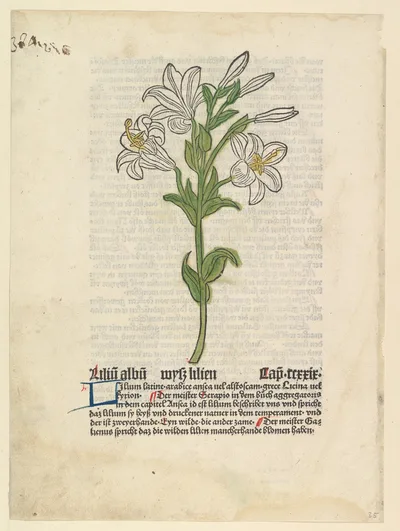
Botanical illustration is the art of drawing and printing plants so that they can be recognised, studied, and admired. Its roots lie in antiquity, in copied manuscripts of Dioscorides' De materia medica, whose pictures were duplicated by hand for centuries and drifted steadily from the living plant. The printing press changed the problem. In the 1530s, Otto Brunfels's Herbarum vivae eicones (1530-36), with woodcuts by Hans Weiditz, showed plants drawn from life, and Leonhart Fuchs's De historia stirpium (Basel, 1542) went further, naming its artists in the book and arguing openly that pictures taught what words could not.
By the late sixteenth and seventeenth centuries the herbal gave way to the florilegium, a book made to display rare garden plants rather than to identify medicines. The grandest example is Basilius Besler's Hortus Eystettensis (1613), a monumental set of engraved plates recording the garden of the Bishop of Eichstatt. In the same period, Maria Sibylla Merian turned the genre toward ecology, drawing insects together with the plants they fed on, culminating in her Metamorphosis insectorum Surinamensium (1705) after her voyage to Suriname.
The eighteenth century brought Linnaeus and a demand for precise, comparable images. Georg Dionysius Ehret, working for patrons across Europe and Britain, learned to draw the reproductive parts that Linnaean classification relied on, and his plates made the new system visible. From about 1750 to 1850, botanical art reached what is often called its golden age: Pierre-Joseph Redouté's stipple-engraved Les Liliacees and Les Roses, Robert Thornton's lavish Temple of Flora (1799-1807), the Bauer brothers' work for Kew and for Sibthorp's Flora Graeca, and William Curtis's Botanical Magazine, launched in 1787 to bring accurately coloured plates to a paying public.
In the nineteenth century lithography and chromolithography moved colour printing away from the hand-coloured copperplate. Artists such as Walter Hood Fitch at Kew produced thousands of lithographic plates, while travellers like Marianne North painted plants in the field. Photography and cheaper reproduction eventually took over the documentary role, but the best of these prints survive as both scientific record and works of art.
A Career in Images
"A picture expresses things more surely and fixes them more deeply in the mind than the bare words of the text."
— Botanical Prints